
Germany
UTC+1Germany offers strong city connectivity, high service reliability, and a mature startup and freelance ecosystem across major hubs.
Freelance and long-stay residence pathways are available depending on nationality and activity model; documentation standards are strict.
Audit date: 2026-03-09
- Avg. download
- 181 Mbps
- Avg. upload
- 93 Mbps
- Median latency
- 24 ms
- Monthly living budget
- $2550/mo
- Coworking pass
- $240/mo
- Prepaid SIM
- $20
Country Briefing
Best fit: Strong fit for nomads who prioritize reliability, structured systems, and deep professional ecosystems in major cities.
Connectivity risk is generally low in major cities; key operational pressure is cost and contract rigidity.
Quick facts
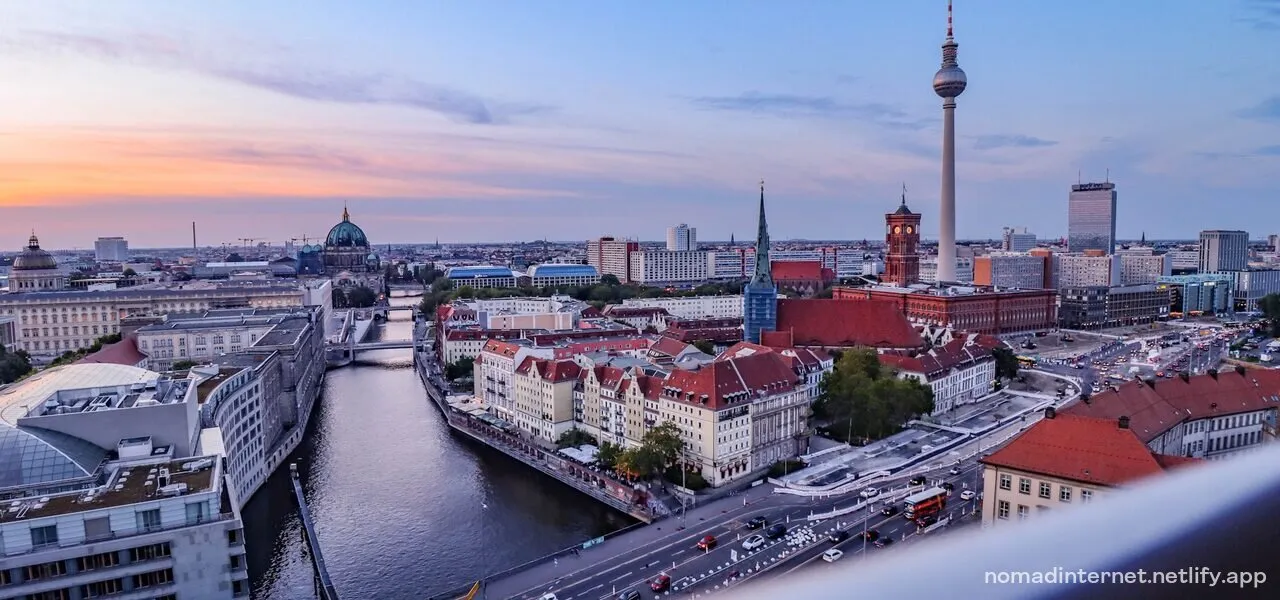
- Berlin remains one of the deepest coworking markets in Europe.
- Service quality is generally stable in major cities.
- Contract terms can be strict, so flexibility checks are mandatory.
- Housing competition in top districts drives up total monthly run-rate.
First-Week Setup
- Fixed Internet Providers in Germany
- 3
- Mobile Operators
- 3
- Nomad-Friendly Cities in Germany
- 3
- Buy eSIM Online
- 3
Checklist
- Review telecom contract duration and cancellation notice before signup.
- Set up one mobile failover plan on day one.
- Benchmark apartment speed on weekday evening peak.
- Bookmark one backup coworking near your transit corridor.
Best Time to Visit
Spring
Mar - May
Cool but brightening. Berlin cafe culture comes alive. Good time to apartment hunt.
Summer
Jun - Aug
Warm (20-30°C), long days. Park culture thrives. Many Germans travel, freeing up sublets.
Autumn
Sep - Nov
Oktoberfest season, colorful foliage. Coworking spaces fill up. Weather cools fast in November.
Winter
Dec - Feb
Cold and dark (0-5°C). Christmas markets. Indoor coworking culture strong. Lower short-term rents.
Nomad Decision Snapshot
Best fit: Strong fit for nomads who prioritize reliability, structured systems, and deep professional ecosystems in major cities.
LowConnectivity risk is generally low in major cities; key operational pressure is cost and contract rigidity.
Strengths
- Stable telecom performance in top urban markets.
- Mature coworking and startup environment in Berlin and Munich.
- Strong service quality and predictable opérations.
Watchouts
- Cost profile is high in top city districts.
- Discounted telecom plans can involve strict term conditions.
- Housing competition can extend onboarding lead time.
Internet Reality Check
- Typical setup lead time
- Setup is faster in already-connected buildings; fresh installs may require landlord/building coordination.
- Contract flexibility
- Flexible monthly options exist, but long-term contracts still dominate best-price tiers.
- Outage pattern
- Outage rates are typically low in core metros; maintenance windows are the more common interruption source.
Area
- Berlin - Mitte
- High — Strong broadband options and dense coworking ecosystem.
- Berlin - Neukolln
- Medium — Good baseline, but building-level contract details matter.
- Munich - Maxvorstadt
- High — Reliable fixed-line profile and strong workspace access.
Mobile Backup Playbook
eSIM options
- Airalo
- 10 GB / 30 days — ~$21. Useful immediate backup for arrival week.
- Nomad eSIM
- 20 GB / 30 days — ~$29. Secondary line option for mobility-heavy routines.
Local SIM setup: SIM activation flow is structured; bring valid ID and expect formal onboarding steps.
Tethering policy: Tethering is broadly supported, with fair-use and speed policies depending on plan.
Fallback playbook
- Keep one mobile failover line active from day one.
- Validate notice periods before signing discounted contracts.
- Pin one coworking backup location near your regular transport route.
Nomad Operations
- Visa
- Residence and freelance pathways exist, but require structured document packages and planning lead time.
- Tax basics
- Tax residency exposure can become material for longer stays; individual structuring should be reviewed professionally.
- Payments and banking
- Card usage is broad in cities, with practical value in keeping both digital and cash options for edge cases.
- Safety
- Major city districts are generally manageable with normal urban vigilance and transport awareness.
- Healthcare
- Healthcare quality is strong in major cities; keeping compliant insurance coverage is advisable for long stays.
Fixed Internet Providers in Germany

Strong brand reliability and broad support infrastructure.

Strong urban footprint with converged offers.

Competitive monthly pricing where supported.
Buy eSIM Online



View all eSIM plans for Germany →
Mobile Operators
Reliable premium option for frequent travel days.
Good balance of speed and metro coverage.

Cost-focused option for flexible monthly setup.
Nomad-Friendly Cities in Germany
- Berlin
- $1650/mo avg. monthly rent — 170 coworking spaces
- Munich
- $1950/mo avg. monthly rent — 88 coworking spaces
- Hamburg
- $1480/mo avg. monthly rent — 82 coworking spaces
Practical Notes
- Plan housing early in top hubs; inventory can tighten quickly in peak periods.
- Confirm contract notice periods before choosing discounted telecom plans.
- If your workflow is meeting-heavy, keep one day-pass coworking backup near transit.
What Digital Nomads Say
"My girlfriend got a physical SIM from T-Mobile after we arrived in Berlin. It actually cost less than my Airalo eSIM. And that SIM worked really well. Also to my surprise the high speed internet in general was not the best. I mean it's fast and stuff, but it wasn't as good as I would expect from one of the most developed countries in Europe."
"The good thing is that you don't need to speak German in Berlin. You will get along with English just fine. I always liked the multicultural hub. But I heard a lot of negatives from people that lived there for longer — very bureaucratic, not so easy to make friends, bad weather."
"Just don't go in winter. It's 6 months of grey skies and vitamin D supplements."
"In certain neighborhoods popular with international residents there is a culture of what I would call 'competitive edginess' where everyone is trying to be as unique or counter-cultural as possible. But it's a huge city and there are tons of 'normal people' who live there too. Choose your neighborhood wisely as it's a geographically very large city."
Similar Countries

Croatia
- Avg. download
- 194 Mbps
- Monthly living budget
- $1850/mo

Portugal
- Avg. download
- 212 Mbps
- Monthly living budget
- $2150/mo

Spain
- Avg. download
- 246 Mbps
- Monthly living budget
- $2350/mo

Estonia
- Avg. download
- 162 Mbps
- Monthly living budget
- $1950/mo

Japan
- Avg. download
- 198 Mbps
- Monthly living budget
- $2650/mo

Vietnam
- Avg. download
- 174 Mbps
- Monthly living budget
- $1400/mo
Sources
- Deutsche Telekom — Last reviewed: 2026-03-09
- Vodafone Germany — Last reviewed: 2026-03-09
- 1&1 — Last reviewed: 2026-03-09
- Make it in Germany — Last reviewed: 2026-03-09
- Florian Wehde / Unsplash — Last reviewed: 2026-03-09
Prices are reference values and can change quickly. Verify on provider websites before purchase.